26.11.07

Archrivals

Before I left I told many of you that I would be going to Rheda-Wiedenbrück, Germany. I've spoken about living in Rheda in many of my posts. What's the difference?

The little hyphen there between Rheda and Wiedenbrück is a lot more controversial than it might seem.

Up until recently, Rheda and Wiedenbrück were separate towns. In fact, Rheda-Wiedenbrück's history is dwarfed by that of Rheda and Wiedenbrück. Wiedenbrück was first a town in 758 AD, while Rheda first got its rights as a town in 952.
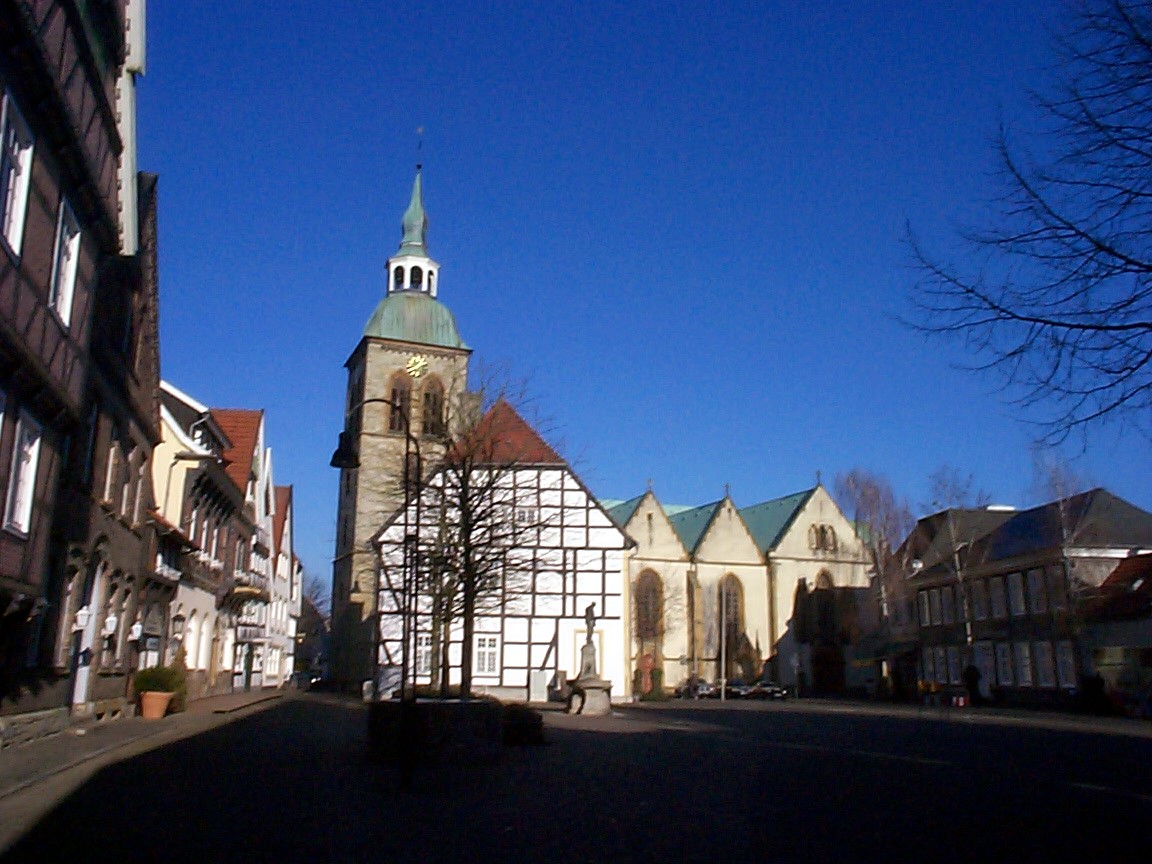


Wiedenbrück marketplace

That means that Wiedenbrück is more than 1000 years older than the US itself. This kind of perspective is hard to keep in mind walking through the cozy little marketplace or "old town" of either Stadtteil.

Throughout the long history, a sort of rivalry developed between Rheda and Wiedenbrück. The way I understand it is: people from Rheda were typically Protestant workers while people from Wiedenbrück were typically Catholic merchants.

Through the history of Germany, and all of Europe for that matter, there was always tension between Catholics and Protestants. Religious and cultural difference are hard to differentiate from each other, but in any case, the towns became even fiercer rivals.

Fast forward to 1970. German bureaucracy wants to reorganize the district and town lines. Rheda and Wiedenbrück, longtime rivals, are now one town. First there's controversy on what to call the new town: Rheda-Wiedenbrück? Wiedenbrück-Rheda? In which town should the town hall be?

Now everything has settled down, the city hall, unfortunately the ugliest building in the town, is in Rheda, and the heated rivalry has turned to a more friendly one. Still, if you want to start an argument in a pub, at a party, or in a classroom, all you have to do is shout "Rheda is better than Wiedenbrück!" and sit back and watch.


As for me, living in Rheda, I've got to defend my adopted home town. But really, both towns have advantages and disadvantages, both are nice towns, and there are nice people in Rheda and Wiedenbrück.

But, we've got the train station and the castle in Rheda. Take THAT, Wiedenbrückers!

19.11.07

At the Movies

So I've only actually been to the movies a few times since I got here, twice at the smaller local theatre that plays artsier films and one at the big chain theater right next to the train station. The first time I saw a German movie about a crazy piano player in a female prison, the second time I saw Rush Hour 3 in German, and the third time I saw a French movie about the Way of St. James, a recently popular pilgrimage in Europe.

Anyway, the most interesting trip to the movies from a cross-cultural point of view was going to watch Rush Hour 3, an American movie with Jackie Chan and Cris Tucker. It was kind of eye-opening to see how America often comes across in movies.

First of all, nothing translates perfectly. That said, the types of things Chris Tucker says in Rush Hour 3 translate absolutely terribly. His German voiceover had an ever higher-pitched voice than he does, and all of the slang translates terribly.
Jackie Chan's part wasn't all that great either. The combination of the two led to a ridiculous display of two main racial groups in America. But the biggest thing I noticed is just how ridiculously America comes through in movies (in any medium, for that matter--TV, music, and magazines, as well).

But it kind of makes sense. Even within America you can get very false impressions about the way things are. I think even Americans have a false impression of Southern California or New York or the South or whatever area just based on movies. Movies essentially show exaggerated versions of stories, of stereotypes, of people, because the average isn't interesting enough.

But don't even get me started on what people see in MTV. One of my classmates always teases me with ridiculous generalizations about what he saw on MTV because he knows he can get me worked up.

It's just a little disappointing in general that some of my least favorite parts of America (bad music, fast food, and superficial pop culture) are the parts that make it over the Atlantic.